Introduction 🌎🎓
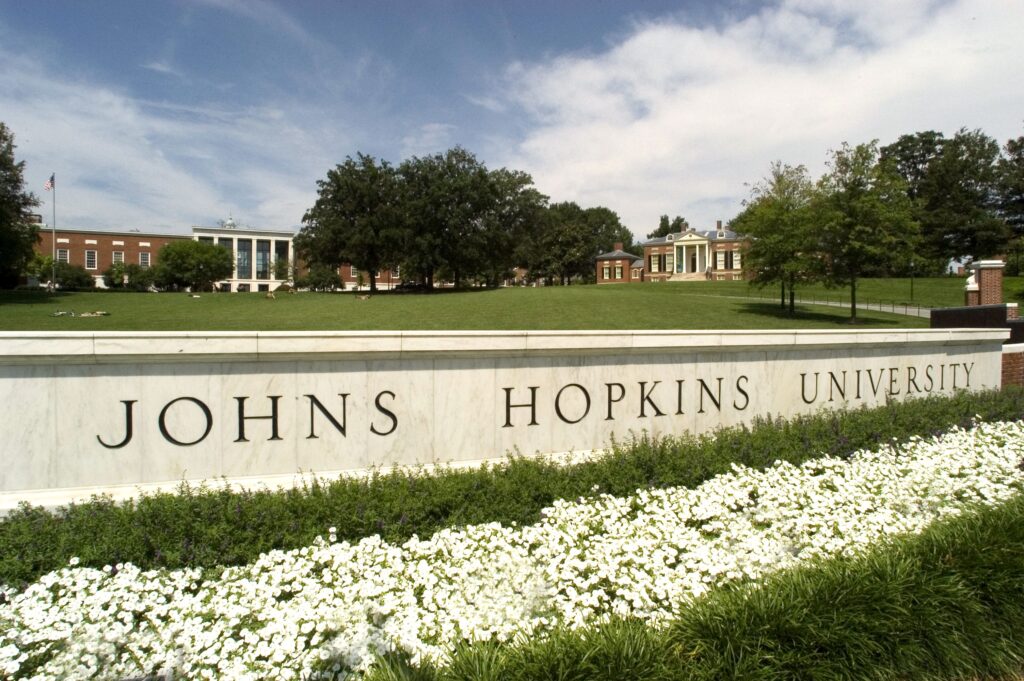
Johns Hopkins University, commonly known as JHU, is one of the world’s most recognized research universities. Located in Baltimore, Maryland, the university has developed a distinctive academic identity built around research, discovery, interdisciplinary learning, and public service. Since its founding in 1876, Johns Hopkins has played an important role in shaping modern approaches to higher education and scientific research.
What makes JHU particularly interesting is its close connection between classroom learning and research. Students are encouraged to investigate questions rather than simply memorize information. Faculty members work across fields such as medicine, public health, engineering, international studies, humanities, social sciences, and the natural sciences. 🔬📚
The university’s influence extends far beyond its campuses. Its research and educational activities connect with communities, hospitals, laboratories, governments, nonprofit organizations, and institutions around the world. For students interested in developing specialized knowledge while participating in a research-oriented academic environment, JHU represents an important institution to explore.
This article looks at Johns Hopkins University from several perspectives, including its history, academic culture, research environment, student experience, technology, global impact, and opportunities for future learners.
The History and Foundation of Johns Hopkins University 🏛️
Johns Hopkins University was established in 1876 through the philanthropic vision of Johns Hopkins, a Baltimore businessman and philanthropist. His bequest supported the creation of both a university and a hospital, creating an institutional model that would eventually become highly influential in American education and medicine.
From its earliest years, JHU emphasized research as an essential part of higher education. Rather than treating universities simply as places where established knowledge was transmitted to students, the institution promoted the idea that universities should actively create new knowledge.
This research-centered philosophy helped shape the university’s academic development. Johns Hopkins became associated with advanced scholarship, laboratory investigation, graduate education, and collaboration between researchers and students. 📖🔬
The university’s historical development also contributed to the evolution of professional and scientific education in the United States. Its graduate programs became particularly important in establishing research-based academic training as a central component of university education.
Over time, JHU expanded into numerous academic disciplines. Today, its schools and programs cover a wide range of fields, allowing students to pursue both highly specialized study and interdisciplinary research.
The history of Johns Hopkins therefore provides useful context for understanding its modern identity. Research is not simply one activity among many at the university; it has been part of the institution’s educational philosophy from the beginning.
Academic Excellence and Diverse Fields of Study 📚✨
One of the defining characteristics of JHU is its broad academic ecosystem. Students can explore subjects ranging from biology and engineering to economics, political science, history, languages, public health, and international affairs.
The university is especially well known for its connections to medicine and health-related research. The Johns Hopkins School of Medicine, Bloomberg School of Public Health, and related research institutions contribute to a major academic environment focused on human health, disease prevention, medical discovery, and population-level challenges. 🧬🏥
At the same time, JHU extends well beyond medical education. Its engineering programs provide opportunities to study areas such as biomedical engineering, computer science, robotics, electrical engineering, and other technological disciplines.
Students interested in international affairs can explore global politics, economics, security, diplomacy, and regional studies. Humanities and social science programs provide additional opportunities to investigate culture, history, communication, society, and human behavior.
This academic diversity encourages interdisciplinary thinking. A student studying computer science, for example, may encounter opportunities to work with researchers in medicine or public health. Similarly, students studying international relations may investigate technological, environmental, or economic issues.
Such connections are increasingly important in the modern world because many major problems cannot be solved through a single discipline. Climate change, global health, artificial intelligence, cybersecurity, and economic development require knowledge from multiple areas. 🌍💡
A Strong Culture of Research 🔬💡
Research is one of the most recognizable features of Johns Hopkins University. Students and faculty participate in investigations designed to expand knowledge and address practical challenges.
Research can take many forms. Laboratory scientists may investigate biological processes, while engineers develop new technologies. Social scientists may analyze human behavior or institutions, and historians may examine archival evidence to understand the past.
For students, exposure to research can be an important part of academic development. Instead of learning only from textbooks, students may have opportunities to analyze data, conduct experiments, review scholarly literature, develop research questions, and communicate findings.
Research also teaches skills that are valuable outside academia. Critical thinking, evidence evaluation, problem-solving, writing, collaboration, and analytical reasoning can be useful in many careers. 🧠📊
The university’s research environment is supported by faculty members working across numerous disciplines. Collaboration between departments and schools can allow researchers to approach complex problems from different perspectives.
Another important aspect is the relationship between research and real-world applications. Scientific discoveries may contribute to medical treatments, technological innovations, public policy discussions, educational approaches, or community programs.
For students who enjoy asking questions and investigating possible answers, this environment can provide a valuable educational experience.
Johns Hopkins and the World of Medicine 🏥🧬
Johns Hopkins has a particularly significant presence in medicine and healthcare. Its medical and public-health institutions have contributed to research, education, clinical practice, and health policy.
The connection between education and healthcare creates opportunities for students and researchers to study health from multiple perspectives. Medicine is not limited to treating individual patients. It also involves understanding diseases, prevention, healthcare systems, environmental factors, genetics, technology, and population health.
Public health is another major component of the university’s global identity. Public-health researchers examine issues affecting communities and populations, including infectious diseases, chronic conditions, health policy, environmental risks, and access to healthcare.
The modern healthcare landscape is becoming increasingly data-driven. Technologies such as artificial intelligence, genomics, medical imaging, wearable devices, and advanced analytics are influencing research and clinical practice. 💻🧬
JHU’s multidisciplinary environment allows scientific and technological fields to intersect with healthcare. Biomedical engineering, computer science, statistics, biology, and public health can all contribute to medical innovation.
For students interested in health-related careers, the university therefore offers an ecosystem where scientific knowledge, technology, and human wellbeing can intersect.
Technology, Innovation, and the Future 🚀💻
Technology is transforming education, research, and professional life. Johns Hopkins University participates in this changing environment through research and academic programs connected to computing, engineering, data science, artificial intelligence, and other emerging technologies.
Artificial intelligence is particularly relevant to modern research. AI systems can help researchers analyze large datasets, identify patterns, model complex systems, and support scientific discovery. However, responsible use requires careful attention to accuracy, privacy, ethics, and human oversight. 🤖🔍
Students working in technology-related fields can benefit from an environment where technical knowledge intersects with real-world problems. A computer scientist may investigate applications in medicine, while an engineer may develop systems designed to support scientific research.
Innovation also requires more than technical ability. Communication, teamwork, ethics, creativity, and an understanding of social consequences are increasingly important.
This is why interdisciplinary education matters. Developing a new technology is only one step. Understanding how people will use it, who may benefit from it, what risks it creates, and how it should be governed can be equally important.
At JHU, the intersection of technology and other academic disciplines provides opportunities to explore these broader questions.
Student Life and Learning Beyond the Classroom 🎒🌟
University life involves much more than lectures, examinations, and research assignments. Students also develop through social interaction, extracurricular activities, leadership opportunities, and community engagement.
At Johns Hopkins, students can participate in organizations, clubs, athletics, cultural activities, academic groups, and community initiatives. These activities can complement formal education by allowing students to explore interests outside their primary fields.
Campus communities can also provide opportunities to meet people with different backgrounds and perspectives. Working with classmates from different disciplines can encourage new ways of thinking.
Student organizations can help learners develop practical skills. Organizing an event, managing a student group, participating in a debate, producing a publication, or volunteering in a community program can involve planning, communication, teamwork, and leadership. 🤝📣
These experiences can become an important part of personal development. University students are preparing not only for examinations but also for professional environments where collaboration and adaptability are essential.
The balance between academic responsibilities and student activities can also teach time management. Managing coursework, research, extracurricular commitments, and personal responsibilities requires organization and realistic planning.
Global Perspectives and International Opportunities 🌍✈️
The modern world is highly interconnected, and universities increasingly provide opportunities for students to develop international perspectives.
Johns Hopkins has academic activities and connections that extend beyond the United States. Students can encounter global issues through international studies, public health, economics, political science, development studies, and other disciplines.
Understanding international problems requires more than studying individual countries. Global challenges often cross borders. Pandemics, climate change, migration, cybersecurity, international trade, and technological development can affect multiple regions simultaneously.
Students who explore global issues can benefit from learning about different political systems, cultures, economies, and historical experiences. 🌐📚
International perspectives can also improve communication skills. Working with people from different cultural backgrounds encourages students to consider how assumptions and communication styles vary across societies.
For future professionals, these experiences can be valuable in fields such as diplomacy, international business, research, healthcare, development, education, technology, and nonprofit work.
The Importance of Interdisciplinary Learning 🔗🧠
Traditional academic boundaries are becoming less rigid. Many of today’s most important questions exist between established disciplines.
Consider climate change. Understanding it requires knowledge of atmospheric science, biology, economics, public policy, engineering, sociology, and international relations. Similarly, artificial intelligence involves computer science but also ethics, law, economics, psychology, and social science.
Johns Hopkins provides an environment where different academic fields can interact. This interdisciplinary approach encourages students to look beyond a single subject and understand how different forms of knowledge connect.
Interdisciplinary learning can also encourage creativity. A solution that is not obvious from one perspective may become possible when researchers combine ideas from several fields. 💡🔗
For students, this means that academic curiosity can extend beyond their major. A student can develop expertise in one field while remaining interested in related disciplines.
Such flexibility can be particularly useful in a rapidly changing job market. Careers increasingly involve technologies and responsibilities that did not exist in their current form a decade ago.
Learning how to learn, adapt, communicate, and solve unfamiliar problems can therefore be as important as mastering a specific technical skill.
Preparing Students for Future Careers 💼🚀
Higher education is often closely connected with career preparation, and JHU provides students with opportunities to develop both specialized and transferable skills.
Specialized knowledge can help students prepare for careers in areas such as medicine, engineering, science, public health, technology, education, government, business, and research.
At the same time, employers frequently value broader abilities such as communication, teamwork, analytical thinking, leadership, and problem-solving. 🎯
Research experience can be particularly useful because it teaches students to approach uncertain problems systematically. Rather than receiving a predetermined answer, researchers often have to determine what information is needed, evaluate evidence, and revise their approach when results differ from expectations.
Internships, projects, student organizations, and professional experiences can further connect academic learning with practical situations.
Career development also involves understanding personal interests and goals. Students may begin university expecting to pursue one career and discover new possibilities through courses, research, mentors, or internships.
This exploration is an important part of higher education. A university experience can provide both specialized training and opportunities to discover new directions.
Research, Ethics, and Responsible Innovation ⚖️🔬
Scientific and technological progress creates opportunities, but it also raises ethical questions.
Medical research, artificial intelligence, biotechnology, data analysis, and other fields can have significant effects on individuals and communities. Researchers therefore need to consider issues such as privacy, informed consent, fairness, safety, transparency, and responsible use.
Universities have an important role in preparing students to think about these questions. Technical expertise without ethical awareness can create problems when innovations are applied without considering their broader consequences.
At JHU, research across medicine, technology, public health, and social sciences provides numerous contexts in which ethical questions become relevant.
For students, ethical education can encourage careful decision-making. Instead of asking only, “Can we develop this technology?” researchers may also ask, “Should it be developed in this form?” and “How might it affect different communities?” 🤔⚖️
Responsible innovation therefore combines creativity with accountability.
Why JHU Remains Relevant in Modern Education 🌟
The educational environment is changing rapidly. Online learning, artificial intelligence, digital research tools, global collaboration, and evolving career requirements are transforming how students learn and work.
Johns Hopkins University’s research-oriented identity remains relevant because it emphasizes curiosity, investigation, and knowledge creation.
The ability to analyze information critically is increasingly important in a world where people encounter enormous quantities of digital content every day. Students need to distinguish evidence from unsupported claims, understand research methods, and evaluate sources carefully.
Universities can contribute to this process by teaching students how knowledge is produced and tested. Research-based education provides an opportunity to understand not only conclusions but also the methods used to reach them. 📚🔎
JHU’s combination of research, professional education, interdisciplinary study, and global engagement provides a model of how higher education can respond to complex modern challenges.
Conclusion 🎓🌍
Johns Hopkins University represents a long-standing tradition of research-driven higher education. From its foundation in the nineteenth century to its modern academic and research activities, the university has maintained a strong emphasis on discovery, scholarship, and service.
Its academic environment encompasses medicine, public health, engineering, technology, international studies, social sciences, humanities, and many other fields. This diversity creates opportunities for interdisciplinary learning and collaboration.
For students, JHU can be viewed not simply as a place to earn a degree but as an environment for developing curiosity, analytical thinking, research skills, communication abilities, and a broader understanding of complex issues.
The university’s continuing connection between education and research illustrates an important principle of modern learning: knowledge is not static. It grows through questioning, experimentation, collaboration, and careful evaluation. 🔬📚
As technology and society continue to evolve, universities such as Johns Hopkins will remain important spaces for exploring new ideas and preparing students to address emerging challenges. Whether the goal is scientific discovery, medical innovation, technological development, public service, or academic scholarship, the principles of curiosity and evidence-based learning remain valuable foundations for the future. 🚀🎓