
🌍 Introduction: A New Era of Learning
Education has always evolved alongside society. From classrooms and printed textbooks to online courses, digital libraries, interactive applications, and artificial intelligence, the way people learn has changed dramatically. By 2030, these changes could accelerate even further, creating an education system that is more personalized, flexible, technology-driven, and focused on lifelong learning.
The future of education will not necessarily mean replacing teachers with technology or transforming every classroom into a virtual environment. Instead, it is likely to involve a deeper connection between teachers, students, artificial intelligence, digital tools, practical experiences, and personalized learning pathways.
Students may increasingly learn at their own pace, receive individualized support from AI-powered systems, collaborate with classmates across countries, and develop skills through simulations and real-world projects. At the same time, teachers could spend less time on repetitive administrative tasks and more time supporting creativity, communication, critical thinking, and human development.
By 2030, education could become less about memorizing information and more about learning how to use information effectively. 🚀


🤖 1. Artificial Intelligence Could Become a Learning Partner
One of the biggest changes in education could come from artificial intelligence.
AI-powered learning systems can already provide explanations, generate practice questions, help students brainstorm ideas, translate content, summarize information, and provide personalized assistance. By 2030, these capabilities could become more deeply integrated into educational platforms.
Instead of giving every student exactly the same learning material, AI systems could analyze a learner’s progress and recommend different activities based on their needs.
For example, if one student struggles with algebraic equations, an AI tutor could provide additional examples and simpler explanations. Another student who has already mastered the topic could receive more advanced problems.
This could create a more personalized learning experience. 📚
AI could also become a useful assistant for teachers. Educators may use AI to prepare lesson materials, generate quizzes, organize classroom resources, analyze learning patterns, and create differentiated activities.
However, human oversight will remain important. Education involves emotional development, social interaction, ethical reasoning, motivation, and relationships—areas where teachers play an important role.
The likely future is therefore not simply AI versus teachers, but AI supporting teachers and students.
🧠 2. Personalized Learning Could Become the Norm
Traditional education often follows a relatively standardized structure. Students of the same age may study the same subject at the same time and complete similar assignments.
By 2030, education could become considerably more personalized.
Personalized learning allows students to move through certain topics according to their abilities, interests, and learning needs. Technology can help educators identify areas where students need additional support while allowing advanced learners to explore more challenging material.
Imagine a student learning biology through a combination of videos, interactive diagrams, simulations, experiments, and AI-guided questions. Another student studying the same subject might prefer reading, discussion, and laboratory activities.
The objective would remain the same, but the path could be different. 🎯
Personalized education could also extend beyond academic subjects. Students might build individual learning portfolios that include technical skills, communication abilities, creative projects, extracurricular activities, and practical experiences.
This could shift education away from a one-size-fits-all model toward a more flexible learning ecosystem.
🥽 3. Virtual Reality and Augmented Reality Could Transform Classrooms
Virtual reality and augmented reality could make learning more immersive.
Instead of simply reading about ancient civilizations, students could potentially explore reconstructed historical environments through VR. Instead of looking at a static diagram of the human heart, learners could examine a three-dimensional digital model.
Science students could explore virtual laboratories. Geography students could experience different environments. Architecture students could walk through digital buildings before construction begins.


Immersive technologies could be especially useful when physical resources are expensive, dangerous, distant, or difficult to access.
A student in one country could potentially participate in a simulated space mission, explore marine ecosystems, or examine a virtual archaeological site without physically traveling there.
However, technology would need to complement—not completely replace—real-world experiences. Hands-on experiments, outdoor activities, laboratories, sports, social interaction, and physical classrooms can all contribute to learning.
🌐 4. Global Classrooms Could Connect Students Across Borders
Digital connectivity could make geography less important in education.
By 2030, students may increasingly participate in international classrooms where learners from different countries work together on shared projects.
A student in India could collaborate with students in Japan, Germany, Brazil, or Canada on an environmental research project. They could exchange ideas, compare local challenges, and develop communication skills while learning about different cultures.
This kind of international collaboration could help students understand that many modern challenges—such as climate change, cybersecurity, public health, and technological development—are global rather than purely local.
Online education could therefore become more than watching recorded lectures. It could involve interactive communities, international collaboration, mentorship, virtual laboratories, and project-based learning.
💻 5. Digital Skills Could Become Fundamental
Digital literacy is already important, but by 2030 it could become as fundamental to education as reading and basic mathematics.
Students may need to understand not only how to use digital devices but also how digital systems work and how to evaluate the information they produce.
Future digital education could include:
- Artificial intelligence literacy 🤖
- Data literacy 📊
- Cybersecurity awareness 🔐
- Online communication 💬
- Media literacy 📰
- Coding and computational thinking 💻
- Digital ethics ⚖️
- Information verification 🔎
The goal would not be to turn every student into a software engineer.
Instead, students could learn enough about technology to use it responsibly and confidently.
For example, when an AI system provides an answer, students should understand that the information needs to be evaluated rather than automatically accepted.
This makes critical thinking increasingly important.
🔎 6. Critical Thinking Could Become More Valuable Than Memorization
The internet has made information easier to access. Artificial intelligence is making information generation even faster.
As a result, memorizing large quantities of information may become less important for some educational tasks.
This does not mean knowledge will become unnecessary. Strong foundational knowledge remains essential because people need background understanding to evaluate new information.
However, education could increasingly emphasize questions such as:
Is this information reliable?
What evidence supports this claim?
Are there alternative explanations?
How can this knowledge be applied?
What are the ethical consequences?
Students may spend more time solving problems, conducting research, debating ideas, building projects, and analyzing evidence.
The classroom of 2030 could therefore be more focused on thinking with knowledge rather than simply storing knowledge.
🧑🏫 7. Teachers Could Become More Like Mentors and Learning Designers
Teachers will likely remain central to education even as technology becomes more sophisticated.
Their role, however, could change.
Instead of spending significant time on repetitive administrative tasks, teachers may increasingly focus on mentoring, discussion, creativity, collaboration, emotional support, and complex problem-solving.
AI could help prepare basic materials, while teachers determine how those materials should be used with particular students.
A teacher could act as a learning designer who combines technology, projects, discussion, experimentation, and real-world experiences.
Human connection will remain particularly important. Students need encouragement, feedback, empathy, motivation, and role models.
Technology can support these experiences, but it does not automatically replace them.
📱 8. Learning Could Become More Flexible
The traditional model of education often separates learning into specific periods: school, college, university, and employment.
The future could make these boundaries less rigid.
People may learn throughout their lives through short courses, professional certifications, online programs, workplace training, university modules, and independent study.
A professional could learn a new data-analysis technique in the evening. A teacher could complete an online certification while working. A university student could combine academic courses with industry projects.
This could lead to a culture of lifelong learning.
Instead of asking, “What degree do you have?” employers and institutions may increasingly consider what skills a person currently possesses and how effectively they can demonstrate them.
🧩 9. Microlearning Could Make Education Easier to Fit Into Daily Life
Microlearning involves studying information in smaller, focused units.
Rather than completing a long lecture, students might learn through short lessons, interactive exercises, quizzes, simulations, and practical tasks.
This approach could be particularly useful for professional education and lifelong learning.
For example, a learner might spend 15 minutes studying a cybersecurity concept, 20 minutes completing a simulation, and another 10 minutes reviewing mistakes.
Short learning experiences could be combined into larger educational pathways.
However, complex subjects cannot always be reduced to short lessons. Deep understanding often requires sustained concentration, reading, discussion, experimentation, and reflection.
The future may therefore combine microlearning for flexibility with deep learning for complex subjects.
🧑💻 10. Online and Hybrid Education Could Continue Growing
The future of education is unlikely to be exclusively online or exclusively classroom-based.
Hybrid education could combine physical classrooms with digital learning.
Students might attend school or university for laboratories, discussions, teamwork, sports, and social activities while completing certain lessons or assignments digitally.
This model could provide flexibility while preserving face-to-face interaction.
Online platforms could also expand access to courses from universities, educators, companies, and specialized training providers around the world.
For learners who live far from major educational centers, this could create new opportunities.
🧪 11. Project-Based Learning Could Become More Important
Education could increasingly move from “learn first, apply later” toward learning through application.
Project-based learning allows students to solve practical problems while developing academic knowledge.
For example, students could design a water-saving system for their school, develop a community recycling project, create a small business plan, build a simple robot, or analyze local environmental data.
Such projects can combine multiple subjects.
A sustainability project might involve mathematics, science, communication, economics, technology, and social studies.
This approach can help students understand why knowledge matters outside examinations.
💼 12. Education Could Become More Closely Connected to Careers
The labor market is changing quickly because of automation, AI, digital technologies, and evolving industries.
Education systems may therefore place greater emphasis on employability and transferable skills.
Future students could develop skills such as communication, teamwork, problem-solving, adaptability, data interpretation, digital literacy, entrepreneurship, and project management alongside traditional academic knowledge.
Universities and schools may also collaborate more closely with employers.
Internships, apprenticeships, simulations, industry projects, and practical assignments could become increasingly integrated into educational pathways.
The objective would be to help learners connect academic knowledge with real-world situations.
🧠 13. Emotional and Social Learning Could Receive More Attention
Education is not only about academic achievement.
Students also need to understand communication, collaboration, emotional awareness, resilience, responsible decision-making, and interpersonal relationships.
As technology becomes more prominent, human skills could become increasingly valuable.
Students may spend more time participating in collaborative activities, group projects, discussions, presentations, creative work, and community projects.
Schools could also place greater emphasis on creating environments where students feel comfortable asking questions and making mistakes during the learning process.
A healthy learning environment can encourage curiosity rather than simply rewarding correct answers.
🔐 14. Digital Safety and Privacy Could Become Essential Subjects
Greater use of educational technology also creates new responsibilities.
Students may share significant amounts of information with digital platforms. Schools and institutions may therefore need strong approaches to privacy, cybersecurity, responsible data use, and online safety.
Students could learn how to create secure passwords, recognize scams, understand privacy settings, identify manipulated information, and behave responsibly online.
Digital citizenship could become a core component of modern education.
The future classroom may therefore teach not only how to use technology but also how to use it safely and ethically.
🌱 15. Sustainability Could Become Part of Everyday Education
Climate change and environmental challenges could influence education by 2030.
Schools and universities may incorporate sustainability across multiple subjects rather than treating it as a separate topic.
Students could study renewable energy through physics, sustainable cities through geography, food systems through biology, environmental economics through economics, and climate communication through language studies.
Schools could also become practical learning environments through solar energy projects, waste reduction programs, water conservation systems, gardens, and environmental monitoring.
This could connect academic knowledge with local environmental challenges. 🌱
📊 16. Learning Analytics Could Help Identify Learning Needs
Digital education platforms can generate information about how students interact with learning materials.
By 2030, learning analytics could become more sophisticated.
Educators may be able to identify patterns such as repeated mistakes, areas of difficulty, engagement changes, or topics where students need additional support.
Used responsibly, this information could help teachers intervene earlier.
However, data should not be treated as a complete representation of a student. Numbers cannot capture every aspect of motivation, creativity, family circumstances, interests, or personal development.
Human judgment will therefore remain important when interpreting educational data.
🧑🎨 17. Creativity Could Become a Core Educational Skill
As AI systems become capable of generating text, images, music, software, and other content, human creativity could take on new forms.
Students may use AI as a creative tool while learning how to develop their own ideas and make meaningful decisions.
A student could use technology to create a prototype, then explain why certain design decisions were made.
Another student could use AI to explore multiple writing approaches before producing an original piece.
Education may increasingly focus on creative direction, originality, judgment, communication, and problem framing.
The important question may become not simply “Can you create something?” but also “Why did you create it, who is it for, and what problem does it solve?”
🏫 18. Classrooms Could Become More Collaborative
The classroom of 2030 may look less like rows of desks facing one teacher and more like a flexible learning environment.
There could be spaces for individual study, group projects, presentations, experimentation, digital learning, and creative activities.
Students could move between different learning modes depending on the task.
For example, they might begin with an AI-supported lesson, move into a small group discussion, conduct an experiment, and finish with an individual reflection.
The physical classroom could therefore become a place for interaction and application rather than simply information delivery.


🌎 19. Access and the Digital Divide Will Remain Important
Technology can expand educational opportunities, but access is not automatically equal.
Students need reliable internet connections, suitable devices, digital skills, supportive teachers, and accessible learning materials.
If some communities lack these resources, technological transformation could create new educational inequalities.
The future of education therefore depends not only on developing advanced tools but also on ensuring that students can actually use them.
Affordable connectivity, accessible educational resources, teacher training, inclusive design, and support for disadvantaged learners could remain important priorities.
🧭 20. Education Could Become More Student-Centered
Perhaps the most significant change by 2030 could be a shift in the student’s role.
Instead of being primarily a receiver of information, the student could increasingly become an active participant in designing their learning journey.
Students may choose specialized courses, combine subjects, create portfolios, participate in projects, collaborate internationally, and learn through different digital and physical environments.
This could encourage greater independence.
However, student-centered education does not mean students should learn entirely on their own. Guidance from teachers, mentors, families, and educational institutions remains important.
🔮 What Could Education Look Like in 2030?
Imagine a student beginning the day in a physical classroom. 🏫
The student starts with a personalized digital lesson generated around their current learning level. An AI assistant provides additional explanations when necessary.
Later, the student joins a group project with classmates from different countries. Using virtual reality, the group explores a simulated environment connected to their science assignment.
After lunch, the student works with a teacher who provides feedback on the project. Instead of simply correcting answers, the teacher asks questions that encourage deeper thinking.
In the afternoon, the student completes a practical project involving data analysis and communication.
At the end of the week, the student’s digital portfolio records projects, skills, reflections, and completed learning experiences.
This vision is not guaranteed to become universal by 2030. Different countries, schools, universities, and communities will adopt technology at different speeds.
But the direction is clear: education is becoming increasingly connected, personalized, flexible, and technology-enabled.
⚖️ The Challenges of Future Education
Technological progress will create opportunities, but it will also introduce difficult questions.
How much AI assistance should students receive?
How can educators distinguish between genuine learning and automated work?
Who controls student data?
How can schools protect privacy?
How can technology be made accessible to students from different economic backgrounds?
How should examinations change when AI can generate answers?
These questions do not have simple technological solutions.
Education systems will need clear policies, teacher training, digital literacy, ethical standards, and ongoing evaluation.
The goal should not be to adopt every new technology simply because it exists.
Instead, educational institutions can ask whether a technology actually improves learning, accessibility, engagement, safety, or educational outcomes.
🌟 The Human Element Will Still Matter
Despite rapid technological change, the most important part of education may remain human.
A teacher who inspires curiosity can have a lasting influence. A classmate can become a lifelong friend. A mentor can help a student discover a career direction. A challenging project can teach persistence.
Technology can provide information and tools, but education also involves relationships, identity, values, creativity, curiosity, and community.
The future classroom may contain more screens, AI systems, simulations, sensors, and digital resources—but students will still need people who listen to them, challenge them, encourage them, and help them understand the world.
🚀 Conclusion: Learning Beyond 2030
The future of education could be more personalized, connected, flexible, immersive, and focused on practical skills. Artificial intelligence may become an everyday learning assistant. Virtual and augmented reality could make difficult concepts more interactive. Digital platforms could expand access to global learning communities, while project-based education could connect academic knowledge with real-world challenges.
At the same time, the future will require careful attention to privacy, equity, digital safety, teacher training, and responsible technology use.
The most successful education systems may not simply be the ones with the most advanced technology. They could be the ones that use technology thoughtfully while preserving the human qualities that make learning meaningful.
By 2030, education may no longer be defined by a single classroom, textbook, timetable, or examination. Instead, learning could become a continuous journey that follows people throughout their lives. 🎓🌍
The future of education is ultimately not just about smarter machines. It is about helping people become better thinkers, creators, collaborators, and lifelong learners.
🖼️ Feature Image Prompt
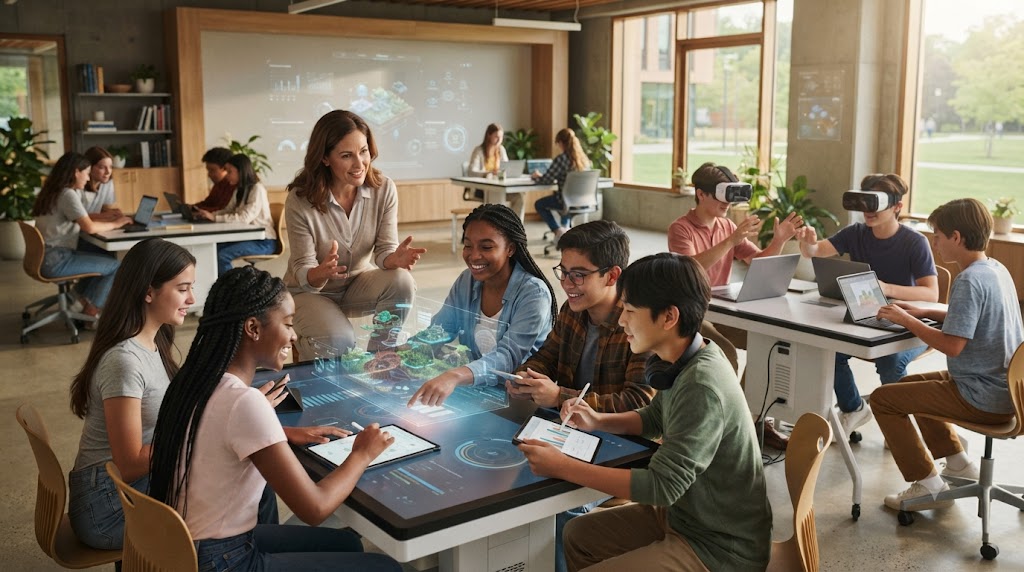
16:9 premium editorial education image: A futuristic but realistic 2030 classroom with diverse students collaborating around interactive digital tables, a teacher guiding a project, subtle AI holographic interfaces, laptops and tablets, virtual-reality learning elements, warm natural classroom lighting, modern sustainable architecture, realistic human expressions, sophisticated educational technology, cinematic composition, premium magazine editorial photography, highly detailed, photorealistic, clean academic atmosphere, no text, no logos, no watermark.