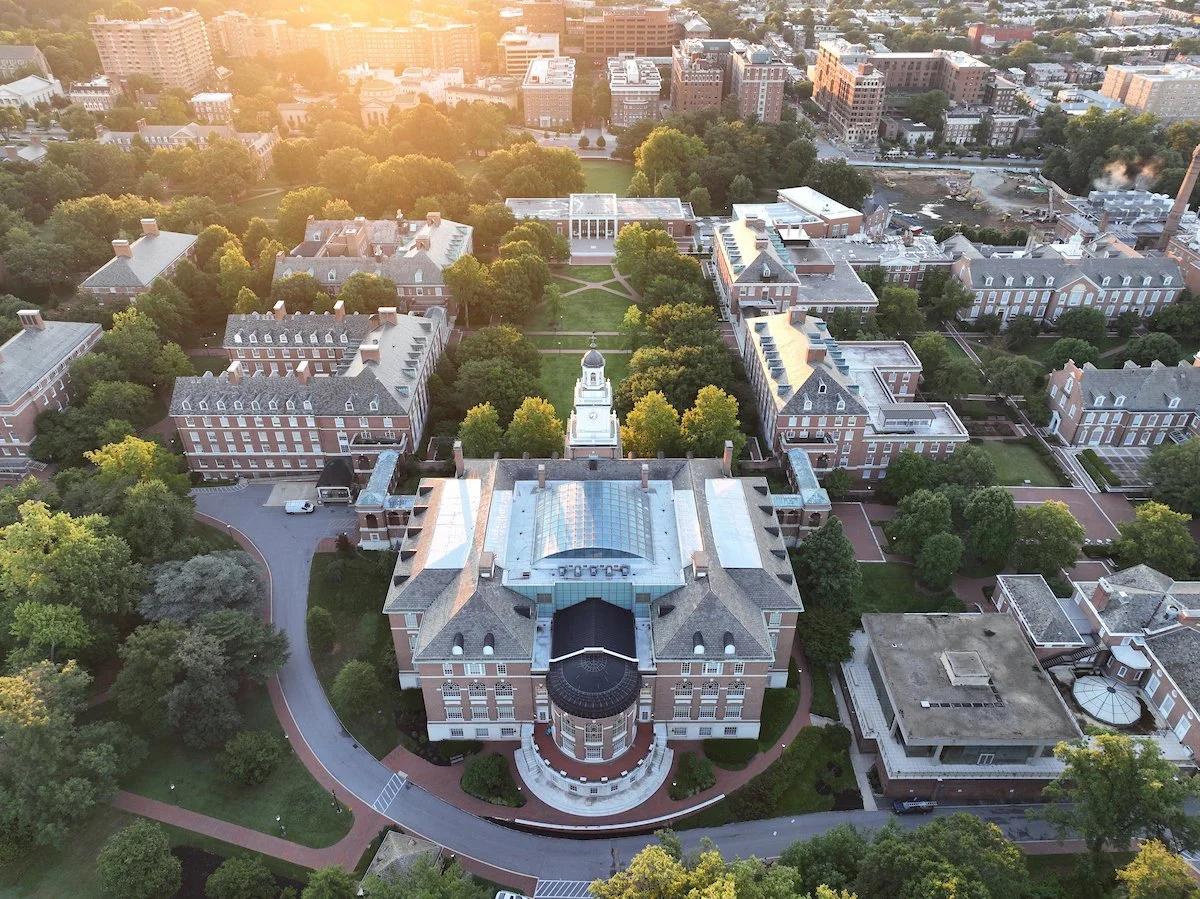

Johns Hopkins University, often known simply as Johns Hopkins or JHU, is one of the world’s best-known research universities. Located in Baltimore, Maryland, the university has built a strong reputation for academic excellence, scientific discovery, medicine, public health, engineering, and interdisciplinary research. 🎓🌎
Founded in 1876 through the vision and philanthropy of Johns Hopkins, the institution introduced an influential model of higher education in the United States that placed research and advanced scholarship at the center of university life. Over time, JHU developed into a large global institution with schools, research centers, hospitals, and academic programs serving students and researchers across numerous disciplines.
What makes Johns Hopkins particularly distinctive is its deep connection between education and research. Students are encouraged to explore questions, investigate evidence, collaborate with experts, and think critically about complex problems. The university’s academic environment extends beyond traditional classrooms into laboratories, libraries, hospitals, research institutes, studios, and international programs. 🔬📚
JHU is especially recognized for its contributions to medicine and public health, but its academic strengths extend far beyond healthcare. Students can pursue studies in engineering, natural sciences, social sciences, humanities, international studies, business, education, music, and many other areas.
For students considering higher education, Johns Hopkins represents an environment where academic curiosity and practical discovery are closely connected. The university offers opportunities for undergraduate students, graduate students, medical professionals, researchers, and lifelong learners.
This article explores the history, academic environment, research culture, student experience, admissions considerations, innovation, global impact, and future direction of Johns Hopkins University.
The History and Foundation of Johns Hopkins University 📜🏛️
Johns Hopkins University was founded in 1876 in Baltimore, Maryland. Its establishment was made possible through the philanthropic vision of Johns Hopkins, a Baltimore businessman and philanthropist whose gift supported both a university and a hospital.
From its beginning, the university embraced an approach that emphasized research, advanced scholarship, and the close relationship between teaching and discovery.
This was an important development in American higher education. Rather than viewing universities primarily as places for transmitting established knowledge, the research-university model emphasized the creation of new knowledge.
That philosophy became a defining part of Johns Hopkins.
The university’s early academic culture encouraged faculty members to conduct original research and involve students in scholarly work. Over generations, this approach helped establish JHU as an institution strongly associated with scientific investigation and intellectual inquiry.
The university also developed a close relationship with medicine and healthcare through the creation of Johns Hopkins Medicine. This connection eventually became an important part of the institution’s identity and global influence.
Today, Johns Hopkins includes multiple academic divisions and professional schools. Its activities extend from Baltimore to research and educational programs around the world.
The university’s history demonstrates how an institution can influence higher education not only through individual discoveries but also through the development of an educational philosophy.
The idea that students should learn through research remains visible throughout many parts of JHU today. 🔬📖
Academic Excellence Across Multiple Disciplines 🎓📚
One of the most attractive features of Johns Hopkins University is its broad academic environment.
Although the institution is internationally famous for medicine and public health, students can study an impressive range of subjects.
The Krieger School of Arts and Sciences provides programs across the humanities, natural sciences, and social sciences.
Students interested in biology, chemistry, physics, mathematics, economics, history, political science, philosophy, languages, and other disciplines can find opportunities to explore their interests.
The Whiting School of Engineering is another major part of the university. Engineering students can study areas such as biomedical engineering, computer science, electrical and computer engineering, mechanical engineering, chemical and biomolecular engineering, and other fields.
The School of Education focuses on teaching, learning, education policy, and educational research.
The School of Advanced International Studies provides opportunities for students interested in international relations, economics, diplomacy, global policy, and related subjects.
The university also includes schools dedicated to medicine, nursing, public health, business, music, and other professional disciplines.
This academic diversity encourages interdisciplinary thinking.
A student studying computer science might collaborate with researchers in healthcare. An engineering student could explore a problem related to public health. A political science student might investigate the relationship between technology and international policy.
Modern problems rarely fit neatly into one academic department.
Climate change, healthcare access, artificial intelligence, cybersecurity, global development, and biotechnology all require knowledge from multiple disciplines.
Johns Hopkins’ broad academic ecosystem provides opportunities for students and researchers to approach these challenges from different perspectives. 🌎💡

The Research Culture at Johns Hopkins 🔬🧪
Research is one of the defining characteristics of Johns Hopkins University.
Students are often encouraged to move beyond memorizing information and instead ask questions, examine evidence, design experiments, analyze data, and develop new interpretations.
The university’s research activities cover a remarkable range of subjects.
Scientists investigate diseases, genetics, neuroscience, biomedical engineering, materials, chemistry, physics, and environmental systems.
Social scientists study economics, politics, education, communication, sociology, and international affairs.
Humanities scholars explore history, literature, languages, philosophy, music, and culture.
Interdisciplinary research brings these areas together.
One particularly important aspect of JHU’s research environment is the connection between academic researchers and clinical or professional institutions.
Medical research can move between laboratories and healthcare settings, creating opportunities to investigate scientific discoveries in relation to real-world health problems.
Students who become involved in research may gain valuable experience in experimental design, laboratory methods, statistical analysis, scientific writing, presentations, and collaboration.
Research can also help students understand how knowledge is created.
Scientific discovery is rarely a simple process. Experiments can fail. Hypotheses can be wrong. Data can produce unexpected results.
Learning to respond to uncertainty is an important part of research education.
This environment can prepare students for graduate study, professional careers, entrepreneurship, scientific research, and other paths requiring analytical thinking.
The research culture at Johns Hopkins is therefore not simply about producing publications.
It is also about teaching students how to investigate difficult questions. 🧠🔬
Medicine and Healthcare Innovation 🏥❤️
Johns Hopkins has a particularly strong global reputation in medicine and healthcare.
Its medical ecosystem combines education, research, clinical practice, and innovation.
The university’s medical programs and affiliated institutions have contributed to developments across numerous areas of healthcare.
Medicine at Johns Hopkins is closely connected with research.
Students and researchers may investigate topics such as cancer, neuroscience, infectious diseases, genetics, cardiovascular health, biomedical engineering, and many other areas.
Public health is another major strength.
The Bloomberg School of Public Health is widely recognized for research and education related to population health.
Public health focuses not only on treating individual patients but also on preventing disease and improving health across communities.
This involves studying factors such as environment, behavior, social conditions, healthcare systems, epidemiology, and policy.
The combination of medicine and public health creates opportunities to approach health challenges from both individual and population perspectives.
Johns Hopkins also has a strong history of biomedical engineering.
Biomedical engineers work at the intersection of engineering and medicine, developing technologies that may support diagnosis, treatment, rehabilitation, monitoring, and research.
This interdisciplinary approach demonstrates an important characteristic of JHU: complex problems are often addressed by bringing multiple areas of expertise together.
For students interested in healthcare, the university provides a broad ecosystem spanning basic science, clinical medicine, public health, engineering, nursing, and healthcare management.
Engineering, Technology, and Innovation ⚙️💻🚀
Technology is transforming nearly every industry, and Johns Hopkins has developed substantial strengths in engineering and technological research.
The Whiting School of Engineering provides opportunities for students to study technical disciplines while also engaging with broader scientific and societal questions.
Biomedical engineering is particularly notable because of its connection to the university’s medical ecosystem.
Students can explore how engineering principles can be applied to biological systems and healthcare.
Computer science is another important area.
Students can study algorithms, artificial intelligence, data science, cybersecurity, software systems, and computational methods.
These skills are increasingly relevant across industries.
Engineering education at JHU often emphasizes problem-solving.
Students may work on projects requiring them to design, test, analyze, and improve systems.
This project-oriented learning can help bridge the gap between theoretical knowledge and practical application.
Innovation also extends beyond traditional engineering.
Technology can be connected to public health, international affairs, education, business, environmental science, and other fields.
An interdisciplinary university environment can therefore support innovation by bringing different perspectives together.
A computer scientist may approach a problem differently from a physician. A designer may see possibilities that an engineer overlooks. A policy researcher may identify social consequences that technical specialists have not considered.
Combining these perspectives can lead to more complete solutions.
For students interested in technology, JHU can provide an environment where technical skills are connected with real-world applications. 💻🌟

Student Life at Johns Hopkins 🧑🎓🏫
University life is about more than academic classes.
Students at Johns Hopkins can participate in organizations, athletics, cultural events, student publications, performing arts, volunteering, research groups, and many other activities.
The Homewood campus in Baltimore provides a traditional university environment with academic buildings, green spaces, libraries, residence facilities, and gathering areas.
Student organizations can help people develop friendships and explore interests outside their academic programs.
Clubs may focus on cultural activities, professional development, technology, entrepreneurship, community service, arts, politics, sports, and hobbies.
Participating in campus organizations can also help students develop leadership and communication skills.
For many students, university life is an important transition into greater independence.
Students manage academic responsibilities while learning how to organize schedules, collaborate with peers, communicate with faculty, and participate in a community.
Baltimore also provides a larger urban environment for students to explore.
The city has a rich history, cultural institutions, restaurants, neighborhoods, museums, and professional organizations.
Being located in a major American city can create opportunities for internships, community engagement, professional networking, and cultural experiences.
The student experience will naturally differ from person to person.
Some students may spend much of their time in laboratories and research groups. Others may focus on athletics, arts, student organizations, or entrepreneurship.
The flexibility of campus life allows students to build experiences around their individual interests. 🎨🏀📚
Learning Beyond the Classroom 🌎📖
A strong university education does not end when a lecture finishes.
At Johns Hopkins, students can encounter learning opportunities through research, internships, projects, performances, conferences, student organizations, and professional experiences.
Experiential learning can be particularly valuable because it allows students to apply academic knowledge in practical settings.
An engineering student might participate in a design project.
A public health student might work with a community organization.
An international studies student might pursue an internship related to global policy.
A biology student might contribute to laboratory research.
These experiences can help students understand what their chosen field looks like outside the classroom.
They can also help students discover new interests.
Sometimes a student enters university believing they want to pursue one specific career and later discovers a different area that better matches their abilities and interests.
Exploration is therefore an important part of higher education.
Interdisciplinary opportunities can make this exploration even more valuable.
Students may discover connections between fields that initially seemed unrelated.
For example, data science can support medical research. Psychology can influence education. Engineering can contribute to environmental sustainability. Economics can inform healthcare policy.
The modern world increasingly rewards people who can connect ideas across traditional boundaries.
Johns Hopkins’ research-oriented environment can encourage this type of intellectual exploration. 💡🌍
Admissions and Preparing for JHU 🎯📝
Admission to Johns Hopkins is highly competitive, and students considering the university should approach the process thoughtfully.
Academic preparation is important.
Students should build strong foundations in relevant subjects while challenging themselves appropriately.
However, university preparation is not only about grades.
Students can also develop meaningful extracurricular interests.
Research, community service, leadership, athletics, artistic activities, entrepreneurship, employment, and other experiences may help students demonstrate curiosity and commitment.
The strongest activities are usually those that reflect genuine interests rather than activities chosen simply to create an impressive résumé.
Students should also spend time understanding the university’s academic programs.
Different schools and programs may have different expectations.
Researching areas of interest can help applicants identify programs that align with their goals.
Personal essays and application materials can provide opportunities to explain intellectual interests, experiences, motivations, and aspirations.
Students should aim for authenticity rather than trying to present an artificial image of perfection.
Preparing for a highly selective university can be stressful, so students should also maintain realistic expectations.
Admission decisions involve many factors and are not a complete measure of a student’s ability or future potential.
There are many excellent universities and educational pathways.
For students who are interested in JHU, careful preparation, genuine curiosity, and a clear understanding of academic goals can make the application process more meaningful. 🎓✨
Scholarships and Financial Planning 💰🎓
The cost of higher education is an important consideration for students and families.
Johns Hopkins provides financial aid programs designed to help eligible students meet educational costs.
Students should research the university’s current financial-aid policies directly because eligibility requirements, application procedures, deadlines, and program details can change.
Financial planning should begin early.
Families can review tuition and fees, housing, food, transportation, books, insurance, and other potential expenses.
Students should also explore external scholarships and other funding opportunities where appropriate.
Understanding the complete cost of attendance can help families make informed decisions.
Financial aid can be particularly important because the published tuition price does not necessarily represent the amount every student ultimately pays.
A student’s financial circumstances can influence the available assistance.
Students should therefore use official university resources when evaluating affordability.
Financial planning is part of preparing for university just as academic preparation is.
A thoughtful plan can reduce uncertainty and help students focus on their education once they arrive on campus. 💙📚

Global Perspectives and International Studies 🌎🌐
Johns Hopkins has a strong international dimension.
The School of Advanced International Studies is particularly associated with global affairs, economics, policy, and diplomacy.
Students interested in international careers can explore topics such as international economics, security, diplomacy, development, energy, regional studies, and global policy.
But global engagement extends beyond one school.
Research at Johns Hopkins frequently involves international collaboration.
Public health research may address diseases affecting multiple regions. Environmental research may examine global challenges. Engineering projects can address technologies relevant across countries.
International students also contribute to campus diversity.
A university becomes intellectually stronger when people with different experiences and perspectives can exchange ideas.
Global education is not simply about studying another country.
It is about understanding how systems interact across borders.
Climate change, pandemics, economic development, cybersecurity, migration, international trade, and technological innovation all demonstrate how interconnected modern society has become.
Students who develop global awareness may be better prepared for careers involving international collaboration. 🌍🤝
Entrepreneurship and Innovation 💡🚀
Universities can play an important role in transforming ideas into practical solutions.
Johns Hopkins provides an ecosystem in which research, engineering, medicine, business, and entrepreneurship can interact.
Students and researchers may develop ideas that have potential beyond academic publications.
Entrepreneurship can involve creating companies, developing technologies, launching social initiatives, or building new approaches to existing problems.
Healthcare innovation is one particularly important area because research discoveries may lead to new diagnostic technologies, medical devices, software systems, therapies, or healthcare services.
Technology entrepreneurship can also connect computer science and engineering with business.
Students can learn how to identify problems, understand users, build prototypes, test ideas, and evaluate markets.
Entrepreneurship education can teach valuable skills even for students who never start a company.
Problem identification, communication, teamwork, project management, and experimentation are useful across many careers.
Innovation is ultimately about more than business.
It is about taking ideas and finding ways to create meaningful value.
That mindset can be applied to science, education, public service, healthcare, technology, and community development. 🚀🌟
Alumni and Career Opportunities 🌟💼
A university’s influence often extends through its alumni.
Johns Hopkins graduates have pursued careers across medicine, science, engineering, government, education, business, arts, technology, research, and public service.
The university’s research orientation can prepare students for graduate and professional education as well as direct entry into the workforce.
Career development can involve internships, networking, research experiences, mentoring, professional organizations, and university resources.
Students should think about career development as a gradual process rather than something that begins immediately before graduation.
Exploring potential careers early can help students identify useful skills and experiences.
For example, a student interested in biotechnology may benefit from laboratory experience and technical coursework.
Someone interested in public policy may seek internships involving government or research organizations.
A future software engineer may focus on programming, algorithms, projects, and technical internships.
Career paths are not always linear.
University graduates may change industries, pursue additional education, launch businesses, or combine multiple areas of expertise.
The ability to learn continuously can therefore be as important as a first job.

Johns Hopkins and the Future of Research 🔬🌌
The challenges facing society are becoming increasingly interconnected.
Artificial intelligence, climate change, emerging diseases, cybersecurity, aging populations, energy systems, biotechnology, and global inequality all involve multiple disciplines.
Research universities are uniquely positioned to address such challenges because they bring together specialists from different fields.
Johns Hopkins can contribute to this future through its combination of medicine, public health, engineering, science, international studies, education, business, and the humanities.
Future research may increasingly involve collaboration between humans and advanced computational tools.
Artificial intelligence can help researchers analyze large datasets, identify patterns, model complex systems, and explore scientific questions.
But human researchers remain essential for developing hypotheses, interpreting results, designing experiments, and determining what questions are worth asking.
The university environment can support this interaction between technology and human expertise.
As new scientific challenges emerge, interdisciplinary research will likely become even more important.
Students entering university today may eventually work in fields that do not yet exist.
The ability to learn, adapt, collaborate, and think critically will therefore be essential.
Why Johns Hopkins Continues to Matter 🌟💙
Johns Hopkins University matters because it represents a particular vision of higher education: learning through discovery.
Its identity has been shaped by research, scholarship, medicine, public health, engineering, and interdisciplinary collaboration.
For students, the university can provide opportunities to explore complex questions and work alongside people engaged in advanced research.
For researchers, it offers a large academic ecosystem with connections across multiple disciplines.
For society, its work can contribute to scientific knowledge, healthcare innovation, education, public policy, and technological development.
Its location in Baltimore also connects the institution to an urban community and a broader regional ecosystem.
Like any major university, JHU is not simply a collection of buildings.
It is a community of students, faculty, researchers, staff, alumni, patients, partners, and surrounding communities.
Its long-term influence depends on how these people use knowledge to address real problems.
The university’s research-centered identity remains particularly relevant in a world where solving complex problems requires both specialized expertise and collaboration across disciplines.
Conclusion: Discover, Learn, and Create the Future 🎓🔬🚀
Johns Hopkins University stands as a prominent example of a research-focused university where education and discovery are deeply connected.
From its nineteenth-century foundation to its modern global academic and medical ecosystem, the institution has emphasized original research, rigorous scholarship, and interdisciplinary learning.
Students can explore fields ranging from arts and sciences to engineering, medicine, public health, international affairs, education, business, and music.
Research provides opportunities to move beyond textbooks and engage directly with questions that remain unanswered.
Student life adds another dimension, giving learners opportunities to develop friendships, leadership abilities, professional connections, and personal interests.
The university’s global perspective reflects the increasingly interconnected nature of modern society.
Perhaps most importantly, Johns Hopkins demonstrates why research universities remain important.
The world faces problems that cannot be solved through memorization alone.
They require curiosity, evidence, creativity, collaboration, experimentation, and persistence.
Whether the challenge involves developing a medical treatment, understanding a social problem, designing new technology, improving education, or responding to a global crisis, universities can provide environments where people are encouraged to ask difficult questions.
For prospective students, Johns Hopkins can represent an opportunity to become part of this culture of discovery.
For researchers, it can provide a platform for advancing knowledge.
For society, it represents an institution whose work can influence science, healthcare, education, policy, and innovation.
The journey through higher education is not simply about earning a degree.
It is about learning how to think, how to investigate, how to collaborate, and how to contribute.
That philosophy remains at the heart of the research-university tradition.
Learn deeply. Question boldly. Research carefully. Create meaningfully. 🎓💡🔬
The future belongs to people who are willing to explore what is not yet understood—and Johns Hopkins University continues to build its identity around that spirit of discovery. 💙🌎🚀