When people think about leading research universities in the United States, Johns Hopkins University (JHU) often stands out for its long tradition of discovery, rigorous academics, and commitment to improving society. Founded in 1876, Johns Hopkins was established as America’s first research university and helped introduce a model in which teaching and original research are closely connected.
Today, the university brings together students, professors, researchers, clinicians, engineers, artists, and scholars across a broad range of disciplines. Its academic environment extends beyond traditional classroom learning, encouraging students to investigate questions, challenge assumptions, conduct research, and transform ideas into practical solutions. 🔬💡


A Historic Beginning That Changed American Higher Education 📚
The history of Johns Hopkins University begins in the nineteenth century with Johns Hopkins, a Baltimore philanthropist and entrepreneur whose bequest established both a university and a hospital. The university opened in 1876 under its first president, Daniel Coit Gilman. His educational philosophy emphasized the importance of combining teaching with original research.
This approach was influential because higher education in the United States had traditionally placed greater emphasis on classical undergraduate education. Johns Hopkins instead developed a research-centered model that encouraged scholars and students to investigate new questions and contribute to expanding human knowledge. The university’s founding philosophy ultimately influenced the development of research universities across the United States and beyond.
Gilman’s vision remains closely associated with the university today. Johns Hopkins describes its mission as educating students, encouraging independent and original research, and bringing the benefits of discovery to society. This philosophy can be summarized through the university’s longstanding phrase, “Knowledge for the world.”
The history of JHU is also complex. Contemporary historical research has prompted the university to examine more deeply the relationship between Johns Hopkins and slavery, including archival and census evidence that complicates older accounts of his life. Recognizing this history provides a more complete understanding of the institution and its origins.
From its earliest years, however, research remained at the center of the university’s identity. That foundation continues to influence how students learn, how professors teach, and how researchers approach problems affecting communities around the world. 🧠🌍
Academic Excellence Across Many Fields 🎓
One of the defining characteristics of Johns Hopkins University is the breadth of its academic offerings. The university has more than 30,000 full- and part-time students across ten academic divisions and offers more than 400 programs spanning health professions, arts and music, humanities, social and natural sciences, engineering, international studies, education, and business.
This academic diversity gives students opportunities to explore subjects from multiple perspectives. A student interested in technology, for example, might combine engineering with computer science, public policy, entrepreneurship, or international studies. Similarly, students studying health-related subjects can encounter perspectives from biology, public health, data science, economics, and social sciences.
The university’s multidisciplinary environment is particularly important in a world where major challenges rarely fit within a single academic category. Climate change, global health, artificial intelligence, cybersecurity, economic inequality, urban development, and emerging technologies all require collaboration among specialists from different backgrounds. 🌱🤖
JHU’s academic culture encourages students to become active participants in learning rather than simply receiving information. Classroom discussions, laboratories, seminars, independent projects, internships, creative work, and research experiences can all contribute to a student’s education.
Faculty members also play an important role in this environment. Students have opportunities to learn from scholars and professionals whose work contributes to their respective fields. The combination of rigorous coursework and interaction with researchers can help students develop analytical thinking, communication skills, creativity, and intellectual independence.
For students seeking an education that connects theory with practical investigation, this research-oriented culture can be especially attractive. Rather than treating research as something reserved exclusively for graduate students, Johns Hopkins provides pathways for undergraduates to participate in discovery as well. 🔎
Research as a Core Part of the JHU Experience 🔬
Research is perhaps the characteristic most strongly associated with Johns Hopkins University. The university describes itself as America’s first research university and emphasizes that faculty and students have worked together on discoveries for more than a century.
The university’s research legacy includes work in areas such as water purification, genetic engineering, public health, medicine, engineering, space science, and the humanities. Researchers connected with Johns Hopkins have contributed to discoveries and innovations that have influenced everyday life as well as specialized scientific fields.
Research at JHU takes place across many disciplines. Biomedical researchers investigate diseases and potential treatments. Engineers develop technologies designed to address practical challenges. Social scientists study communities and institutions. Historians examine the past to better understand the present. Computer scientists explore artificial intelligence and computational methods. Scientists study fundamental questions about nature, while scholars in the arts and humanities investigate culture, language, philosophy, and human expression.


The scale of this research environment is significant. Johns Hopkins reports that it has led the United States in federal research and development funding each year since 1979. The university’s Applied Physics Laboratory also contributes substantially to research involving national security, engineering, space, technology, and other complex challenges.
For students, the importance of research extends beyond statistics. Research teaches people how to ask better questions, evaluate evidence, test ideas, deal with uncertainty, communicate findings, and learn from unsuccessful experiments. These abilities are valuable not only in laboratories but also in business, government, education, technology, healthcare, and many other careers.
Opportunities for Undergraduate Researchers 🧪✨
A major advantage of studying at a research-focused university is the opportunity to become involved in projects while still an undergraduate. Johns Hopkins states that students can pursue research across disciplines and may begin participating as early as their first year.
Research opportunities can look very different depending on a student’s field. A biology student may work in a laboratory, while an engineering student could develop a prototype. A history student might conduct archival research, and a computer science student might build a software system or investigate an artificial intelligence problem.
This flexibility is important because research is not limited to one definition of discovery. Creating a new scientific finding, developing a technological tool, interpreting historical evidence, producing creative work, or identifying a new way to understand a social problem can all represent meaningful intellectual contributions.
Johns Hopkins provides resources intended to help students locate and fund research opportunities. Its undergraduate research initiatives include grants and fellowship programs that can support independent projects and faculty-mentored work.
The university’s admissions information also emphasizes several benefits of research-oriented learning: asking thoughtful questions, connecting ideas, testing theories, and communicating findings.
These experiences can help students develop confidence. Instead of simply asking whether an answer is correct, researchers learn to ask how an answer can be demonstrated. They learn that uncertainty is not necessarily failure and that unexpected results can lead to better questions.
This mindset can be valuable throughout life. 🌟 A student who learns how to investigate a difficult question in college may later apply the same approach to designing a medical device, launching a company, developing a public policy, or solving an engineering challenge.
Innovation, Medicine, and Public Health 🩺🌎
Johns Hopkins has an especially strong connection to medicine and public health. The university’s broader ecosystem includes schools, research centers, healthcare institutions, and professional programs that contribute to medical education, scientific discovery, patient care, and population health.
Its research history includes important contributions to medicine and public health. Johns Hopkins highlights discoveries and innovations involving CPR, water purification, surgical procedures, public health interventions, and numerous other areas.
The connection between research and healthcare is particularly important in modern society. Medical challenges increasingly require collaboration between biology, engineering, data science, public policy, behavioral science, and clinical practice.

Public health provides another example. The Johns Hopkins Bloomberg School of Public Health conducts research and educational activities involving communities and health challenges around the world. The university reports that the school has ongoing work in more than 100 countries.
This global perspective matters because health problems do not stop at national borders. Infectious diseases, environmental risks, nutrition, addiction, maternal health, healthcare access, and emergency preparedness can affect populations across continents.
Students exposed to this environment can learn to think about health at multiple levels. One perspective might focus on an individual patient, while another examines an entire population. A third could investigate the economic or social factors influencing health outcomes.
This multidisciplinary approach demonstrates why modern universities increasingly value collaboration. A breakthrough may require a scientist to work with an engineer, a physician, a statistician, a policy specialist, or a community organization.
A Global University With an International Perspective 🌍✈️
Although Johns Hopkins has deep roots in Baltimore, its academic and research activities extend far beyond the United States. The university describes itself as an institution committed to preparing students to become global leaders and citizens.
International education is part of this mission. Students can participate in study-abroad programs, academic exchanges, collaborative research, and international projects. Johns Hopkins reports that undergraduate students participate in international experiences in more than 50 countries worldwide.
The university also has a long history of international engagement. Its School of Advanced International Studies has campuses on three continents and has educated students in international relations for decades.
Global learning can broaden a student’s understanding of complex issues. Studying in another country can expose students to different educational systems, cultures, economic conditions, political structures, and approaches to problem-solving.
For today’s students, international awareness is increasingly valuable. Businesses operate across borders, research collaborations involve scientists from different countries, and technological developments can influence people worldwide within a matter of hours.
A global university therefore does more than provide opportunities to travel. It encourages students to understand that many problems require international cooperation. 🌐
Campus Life and the Student Experience 🏫
Academic achievement is an important part of university life, but students also need opportunities to build friendships, participate in organizations, explore interests, and develop personally.
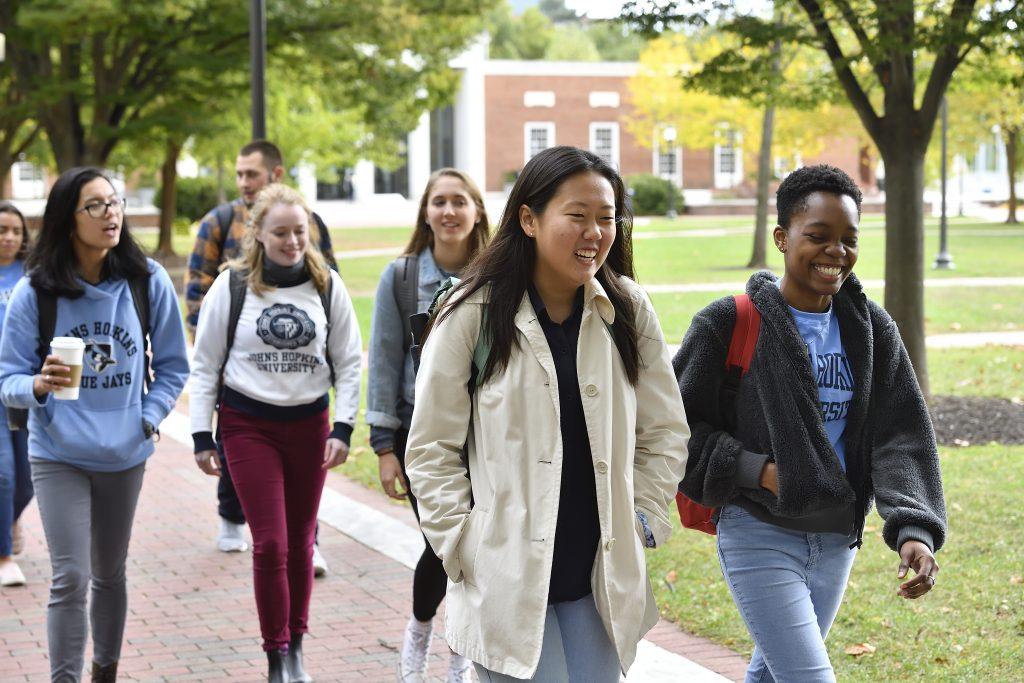
The Homewood campus in Baltimore provides a recognizable setting for undergraduate life, with historic architecture, green spaces, classrooms, libraries, laboratories, and student gathering areas. Images of the campus frequently show students walking between classes, studying outdoors, and participating in everyday university activities.


The student experience can extend well beyond lectures and assignments. Clubs, organizations, cultural activities, athletics, community engagement, research groups, and creative projects can help students discover interests outside their primary fields of study.
A strong university community also benefits from diversity of perspectives. Students arrive with different academic interests, experiences, cultures, ambitions, and ways of thinking. Interacting with people who approach problems differently can challenge assumptions and encourage intellectual growth.
For many students, these informal experiences become an important part of their education. A conversation with a classmate may lead to a research idea. A student organization may develop leadership skills. A campus event may introduce someone to a field they had never previously considered.
In this sense, university learning does not happen only inside classrooms. It happens in laboratories, libraries, residence spaces, campus organizations, public events, and conversations between students and faculty. ☕📖
Preparing Students for the Future 🚀
Higher education is increasingly expected to prepare students not only for their first job but also for careers that may change significantly over time. Johns Hopkins’ research-centered model provides an environment in which students can develop adaptable skills.
Critical thinking is one of these skills. Students must learn how to evaluate evidence rather than automatically accept information. In an era of rapidly spreading digital content and artificial intelligence, the ability to distinguish reliable information from unsupported claims is increasingly important.
Communication is equally important. Researchers must explain complex ideas clearly to colleagues, policymakers, communities, and the general public. Students who learn to communicate scientific, technical, or humanistic ideas effectively can apply that ability in many professional settings.
Collaboration is another major skill. Modern innovation frequently occurs through teams rather than isolated individuals. Students who become comfortable working with people from different disciplines may be better prepared for workplaces where engineers, designers, analysts, managers, researchers, and communicators work together.
Finally, research teaches resilience. Experiments do not always produce expected results. Projects can change direction. Hypotheses can prove incorrect. Historical interpretations can be challenged. Technical systems can fail.
Learning how to respond constructively to these situations can be one of the most valuable lessons of higher education. 💪
Technology and the Future of Discovery 🤖🔬
Technology is transforming almost every area of education and research. Artificial intelligence, advanced computing, biotechnology, robotics, data analytics, and digital communication are creating new opportunities while also raising important questions.
At a research university such as Johns Hopkins, technology can connect disciplines that were once separated. Biomedical researchers can use computational tools to analyze complex datasets. Engineers can develop intelligent systems. Public health researchers can study population-level information. Social scientists can use digital methods to understand human behavior.
The university’s research environment also includes the Applied Physics Laboratory, where researchers work on technically demanding problems. This demonstrates how research can connect fundamental scientific questions with real-world applications.
The future of higher education will likely depend increasingly on interdisciplinary collaboration. A student studying computer science may need to understand ethics. A medical researcher may require advanced data analysis. An engineer may need knowledge of environmental sustainability. A business leader may need to understand biotechnology or artificial intelligence.
This is why universities must create environments where students can cross traditional academic boundaries. Johns Hopkins’ broad academic structure provides opportunities for such connections. 🌐💻
Why Johns Hopkins Continues to Matter ⭐
The importance of Johns Hopkins University is not simply based on its age or reputation. Its continuing significance comes from the relationship between education, research, innovation, and service.
Since its founding in 1876, the institution has helped establish the research university as an important model of American higher education. Its philosophy emphasizes that teaching and discovery can strengthen one another.
That idea remains relevant today. Students need access to knowledge, but they also need opportunities to create new knowledge. Researchers need advanced facilities, but they also need students who bring fresh questions and perspectives. Society needs discoveries, but it also needs people capable of translating those discoveries into meaningful solutions.
Johns Hopkins brings these elements together through its academic divisions, research programs, healthcare connections, international activities, and student opportunities.
The university’s global impact also demonstrates the potential reach of higher education. A research project that begins in a laboratory can eventually influence medical practice. A historical investigation can reshape public understanding. An engineering innovation can become a useful technology. A public health study can inform policy.
This connection between knowledge and practical impact is central to the university’s identity. 🔎🌍
Conclusion: Knowledge With a Purpose 🎓🌎
Johns Hopkins University represents a distinctive vision of higher education—one in which students are encouraged not only to learn existing knowledge but also to question, investigate, create, and contribute.
From its beginnings in 1876 as America’s first research university to its modern global research network, JHU has maintained a strong emphasis on discovery. Its academic programs span numerous disciplines, while its research activities address subjects ranging from medicine and public health to engineering, science, international affairs, humanities, and technology.
For students, the university offers an environment where curiosity can become action. Research opportunities can introduce undergraduates to real-world investigation, while interdisciplinary programs can help them connect ideas across traditional academic boundaries.
For researchers, Johns Hopkins provides a broad ecosystem for collaboration and innovation. For communities, its discoveries and educational initiatives can contribute to health, technology, culture, and economic development.
Most importantly, the story of JHU demonstrates that education can have a purpose beyond earning a degree. It can encourage people to ask better questions, pursue evidence, collaborate across differences, and use knowledge to address meaningful challenges.
That philosophy remains powerful in the twenty-first century. As society confronts increasingly complicated questions about health, technology, climate, education, and global cooperation, institutions that connect learning with discovery will continue to play an important role.