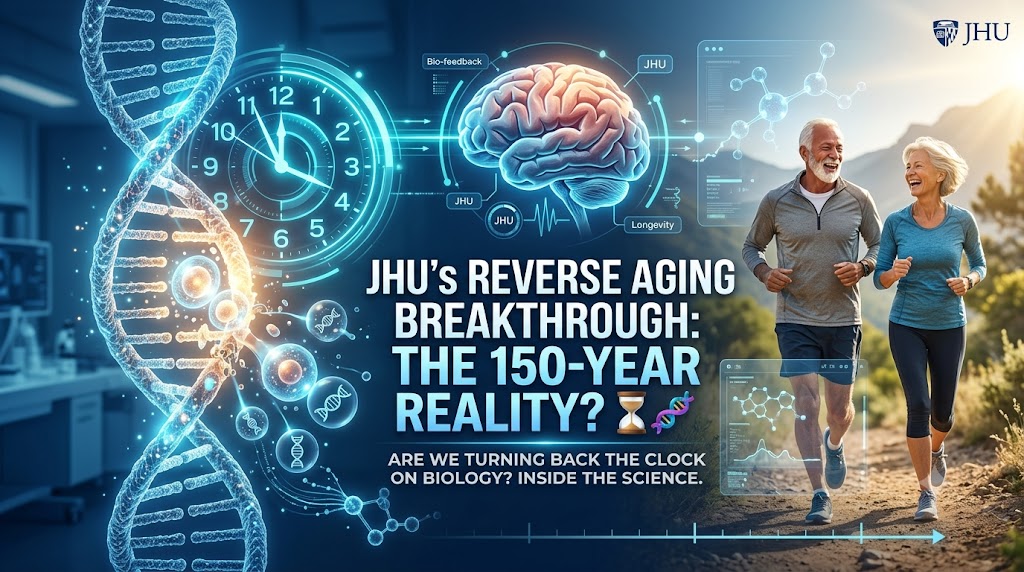

Imagine celebrating your 100th birthday but feeling like you’re only 30. No aching joints, no memory fog, and enough energy to climb a mountain. 🏔️⚡
For decades, science fiction promised us a “fountain of youth.” But right now, researchers at Johns Hopkins University (JHU) and major longevity hubs are turning fiction into reality. We aren’t just talking about living longer; we are talking about biologically turning back the clock. 🔄⌚
So, how close are we really to hitting the 150-year milestone? Let’s dive into the mind-blowing science coming out of the labs.
🛑 The Shift: Aging is Now a Treatable Disease
For centuries, humanity viewed growing frail as an inevitable part of life. Not anymore.
Scientists now classify aging as a complex cellular medical condition. The goal of modern longevity research isn’t to stretch out the years we spend sick in a hospital bed. Instead, it’s about expanding our healthspan—the number of years we live completely free of chronic disease. 🏥❌
“If you only treat individual diseases like cancer or heart disease, you only extend human life by about 2.5 years because something else will break. But if you treat the root cause—aging itself—everything changes.”
🧬 3 Massive Longevity Breakthroughs Happening Right Now
The fight against the biological clock is being fought on three main fronts. Here is what has the scientific community buzzing:
1. The Human Aging Project & “Gerotech” ⚙️👵
At Johns Hopkins, medicine is meeting engineering. JHU’s newly launched translational research hub under the Human Aging Project (HAP) is using AI and advanced cellular biology to target “frailty.” They are actively studying things like mitochondrial injury (how our cellular power plants break down over time) to discover how to jumpstart old cells back to full strength.
2. Epigenetic Reprogramming: “Polishing” Our DNA 💿✨
Think of your DNA like a classic music CD. Over time, the CD gets scratched, and the music skips—that’s aging. Epigenetics is the science of polishing those scratches away. Using modified genetic factors (known as Yamanaka factors), scientists have already successfully reversed aging in animal tissues by up to 75%. Human clinical trials targeting cellular regeneration are already entering early stages. 👁️🐒
3. Cellular Housecleaning (Senolytics) 🧼🦠
As we age, some cells become “zombie cells” (senescent cells). They refuse to die, and instead, sit in our bodies secreting toxic inflammation that damages surrounding tissues. JHU researchers and longevity experts are testing senolytic drugs designed to selectively hunt down and destroy these zombie cells, allowing new, youthful cells to take their place.
📈 The Longevity Toolkit: What You Can Do Today
While we wait for FDA-approved genetic age-reversal therapies to hit the market, major longevity studies have highlighted a few existing compounds that show incredible anti-aging promise:
-
Metabolic Rejuvenators: Common therapies that regulate insulin and metabolic signaling are showing unexpected secondary benefits, acting as multi-system rejuvenators that protect major organs. 🫀
-
Mitochondrial Boosters: Supplements that lower oxidative stress and keep your cells’ powerhouses clean are heavily trending for preserving cognitive functions. 🧠
-
The Power of Combination: Recent data shows that combining different cellular stress-response therapies creates a compounding effect, vastly outperforming single treatments. 🧬💊
🔮 The Verdict: Will We Live to 150?
We are officially living through the most significant health transformation since the discovery of modern vaccines. 💉🌟
While an average lifespan of 150 might still be a couple of generations away, living a highly active, disease-free life well into your 90s or 100s is likely to become the standard much sooner than you think. The biological clock isn’t set in stone anymore—it’s a dial, and science is finally learning how to turn it backward.
📣 What do you think?
Would you want to live to 150 if you could keep the body of a 30-year-old? Let us know in the comments below! 👇💬